Introduction
"How much does an injection mold cost in India?" sounds like it should have a simple answer. It does not — and any supplier who gives you a single number without seeing your part is guessing. Two molds producing parts of the same size can differ in price by a factor of ten, purely because of steel grade, cavity count, and tolerance. The real answer is a set of well-understood cost bands, plus the engineering logic that decides where your specific tool lands within them.
This guide gives you both. Written from the perspective of a tooling engineer who prices molds for a living, it lays out realistic 2026 price ranges by mold type in India, the nineteen factors that move the number, the hidden costs that inflate a project after the purchase order, and — because most readers are weighing India against other sourcing options — an honest country-by-country comparison against China, the USA, Germany, and Vietnam.
It is written for the people who actually make the buy: OEM manufacturers, procurement managers, product engineers, and international buyers from the USA, Canada, Germany, the UK, wider Europe, the UAE, Australia, Japan, and Southeast Asia who are evaluating India as a tooling source. The goal is straightforward — help you budget accurately, avoid the false economy of the cheapest quote, and know exactly what to ask for when you request a quotation.
All figures below are indicative market ranges for budgeting. Steel, engineering plastics, and imported hot-runner components move with the market, so an accurate price only comes from a reviewed drawing.
Why Injection Mold Cost Matters Before You Start Production
The mold is the foundation of your entire production programme, and it is the one decision that is expensive to reverse. Once steel is cut, changes are costly; once the tool is in production, its cavity count, cooling, and steel grade quietly govern the cost of every part you make for years.
Getting the cost decision right upfront matters for three reasons:
It sets your cost per part. Tooling is a one-time investment amortised across every part the mold produces. Under-invest and you pay in scrap, slow cycles, and early re-tooling; over-invest and you tie up capital you did not need to spend.
It determines your quality ceiling. A tool built with the right steel, cooling, and tolerances holds quality across the full production life. A tool built to a price often drifts out of tolerance as it wears — and the parts drift with it.
It shapes your total cost of ownership. For international buyers, the tool price is only part of the equation. Lead time, freight, duties, maintenance, and reliability all belong in the calculation. A slightly higher tool from a capable partner frequently wins on landed, lifetime cost.
The buyers who consistently get good outcomes stop asking "what is the cheapest mold?" and start asking "what is the lowest total cost per part across the life of this programme?" That single shift changes almost every decision that follows.
What Is an Injection Mold?
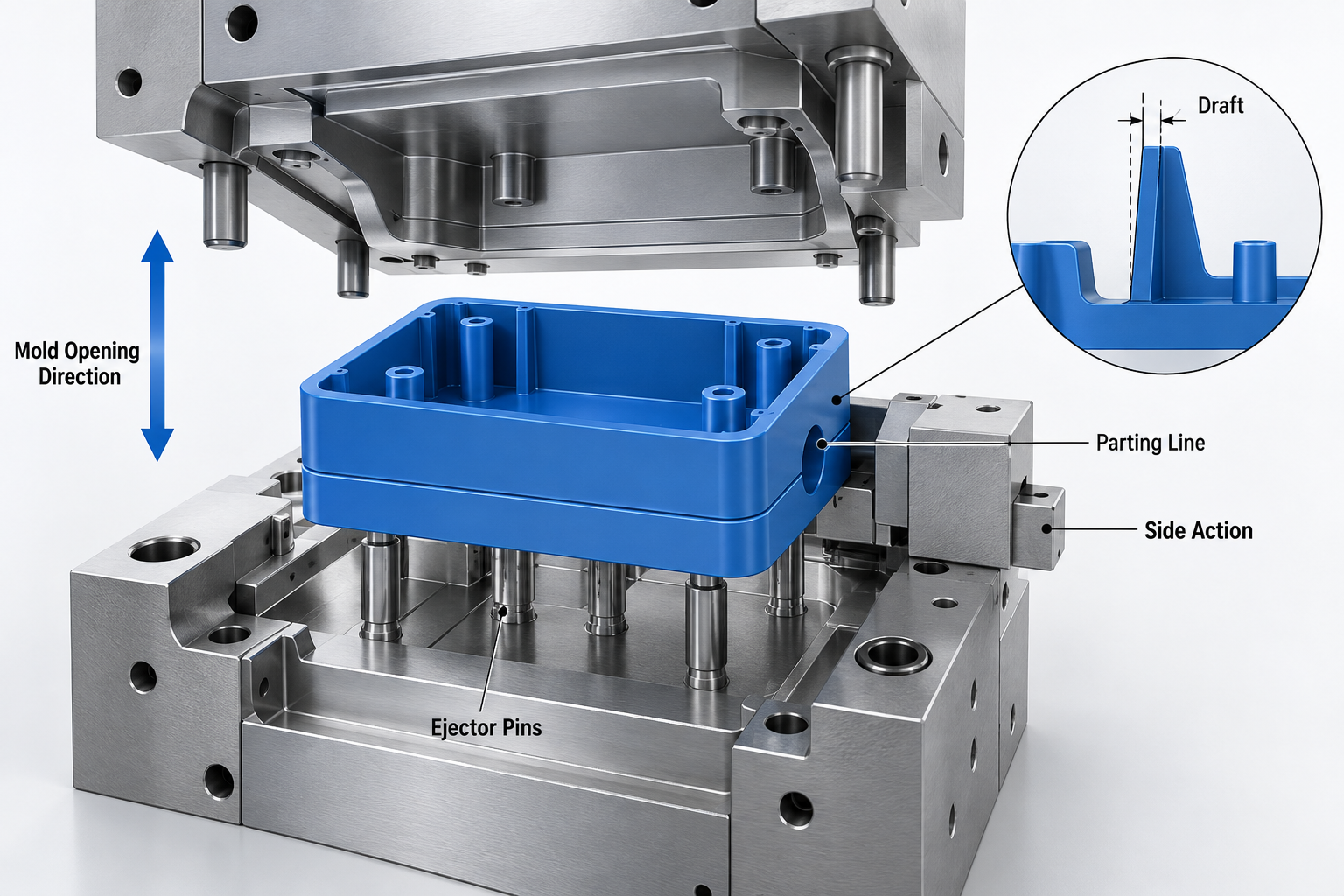
An injection mold — also called tooling or a die — is the precision-machined steel tool that shapes molten plastic into a finished part. Resin is heated until it flows, injected under high pressure into a cavity, held while it cools and solidifies, then ejected. Understanding its main components helps you read a quotation and see where cost accumulates.
Mold base. The steel frame that houses and aligns all other components. Larger parts need larger, heavier bases and more steel — a direct cost driver.
Core. The half that forms the internal geometry of the part. Complex internal features raise core machining cost.
Cavity. The half that forms the external surface. Cosmetic parts demand a high-quality cavity finish, which adds skilled finishing hours.
Ejector system. Pins, sleeves, or plates that push the finished part out of the mold. Complex ejection (for delicate or intricate parts) adds design and machining cost.
Cooling channels. A network of drilled or conformal channels that circulate coolant to control part temperature. Good cooling shortens cycle time for the life of the tool, so it is one of the highest-return investments in a mold.
Gate system. The controlled opening through which plastic enters the cavity. Gate type and location affect fill, cosmetics, and cost.
Hot runner. A heated feed system that keeps plastic molten right up to each cavity, eliminating runner waste and shortening cycles. It costs more upfront — the manifold and controllers are precision, often imported, components — but pays back at volume.
Cold runner. An unheated feed system where the runners solidify with each shot and are ejected as scrap or regrind. Cheaper to build, best suited to lower volumes.
Every one of these elements is a line in the tooling cost. When you see a quotation, you are seeing the sum of the steel, the machining hours, the mechanisms, the finishing, and the validation across all of them.
Average Injection Mold Cost in India (2026)
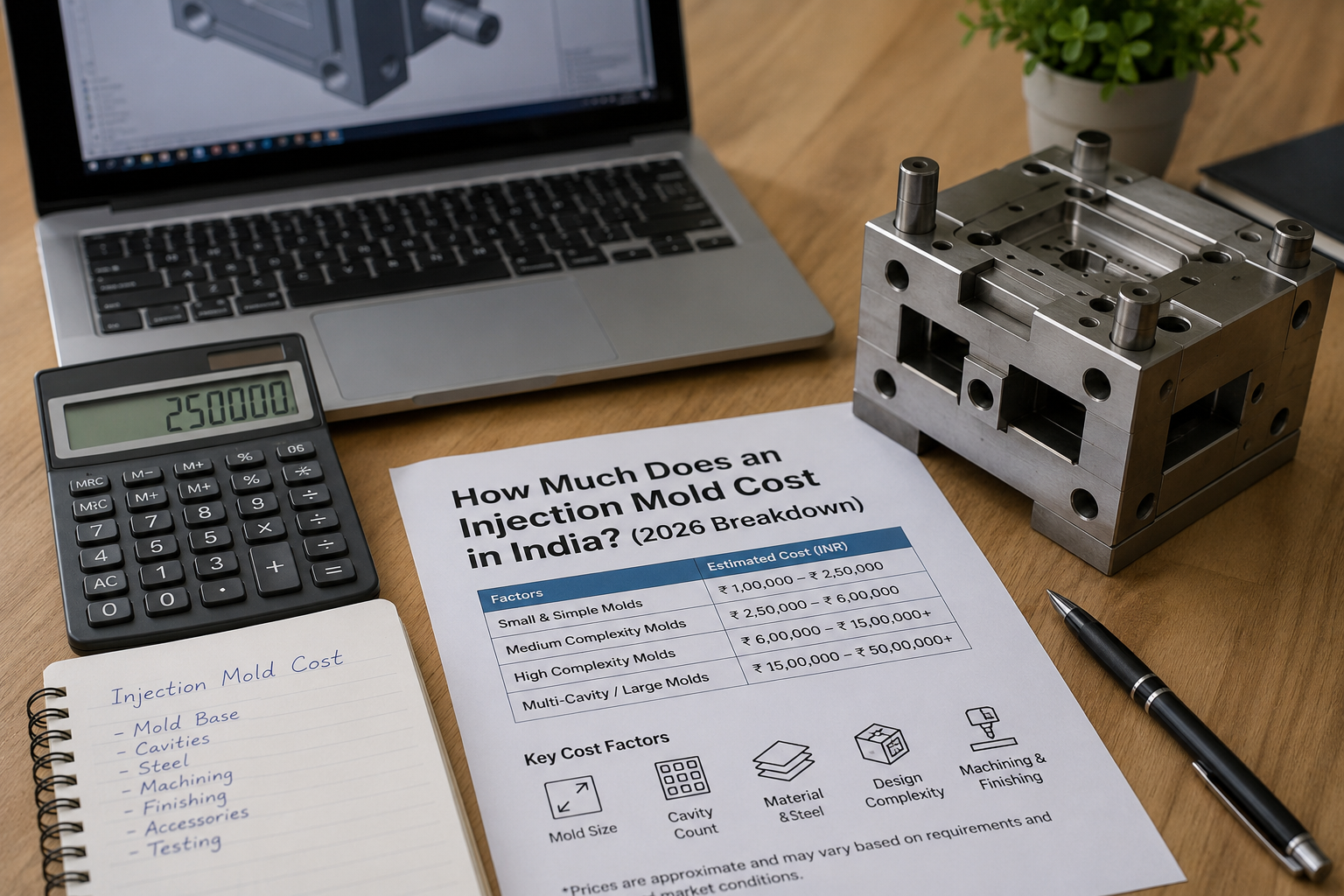
Molds are easiest to budget by type. The table below gives indicative 2026 ranges in India, with approximate USD equivalents (at roughly ₹85 to the US dollar; currency and material prices fluctuate).
| Mold type | Typical use | Indicative cost (INR) | Approx. USD |
|---|---|---|---|
| Prototype mold | Design validation, aluminium/soft steel, low shots | ₹80,000 – ₹3 lakh | $950 – $3,500 |
| Low-volume mold | Market testing, bridge production | ₹2 – 5 lakh | $2,400 – $6,000 |
| Production mold | Single/low-cavity hardened steel, ongoing runs | ₹4 – 12 lakh | $4,700 – $14,000 |
| Multi-cavity mold | High-volume, several cavities per cycle | ₹8 – 25 lakh | $9,400 – $29,000 |
| Family mold | Multiple related parts in one tool | ₹8 – 20 lakh | $9,400 – $23,500 |
| High-precision mold | Tight tolerance, hot runner, cosmetic/medical/2K | ₹15 – 40 lakh+ | $18,000 – $47,000+ |
A few points on interpretation. First, these bands overlap because the same part can shift bands with one decision — add a hot runner, double the cavities, or tighten a critical dimension and a "production" tool becomes a "high-precision" one. Second, prototype and low-volume options exist precisely so you do not have to fund a full production tool before your design and demand are proven. Third, the headline tool price is never the whole cost — see hidden costs below.
For orientation, most commercial production tooling in India sits in the ₹4–15 lakh range. The extremes — very small aluminium prototypes below, and large high-cavitation or two-shot tools above — bracket that middle.
Major Factors Affecting Injection Mold Cost
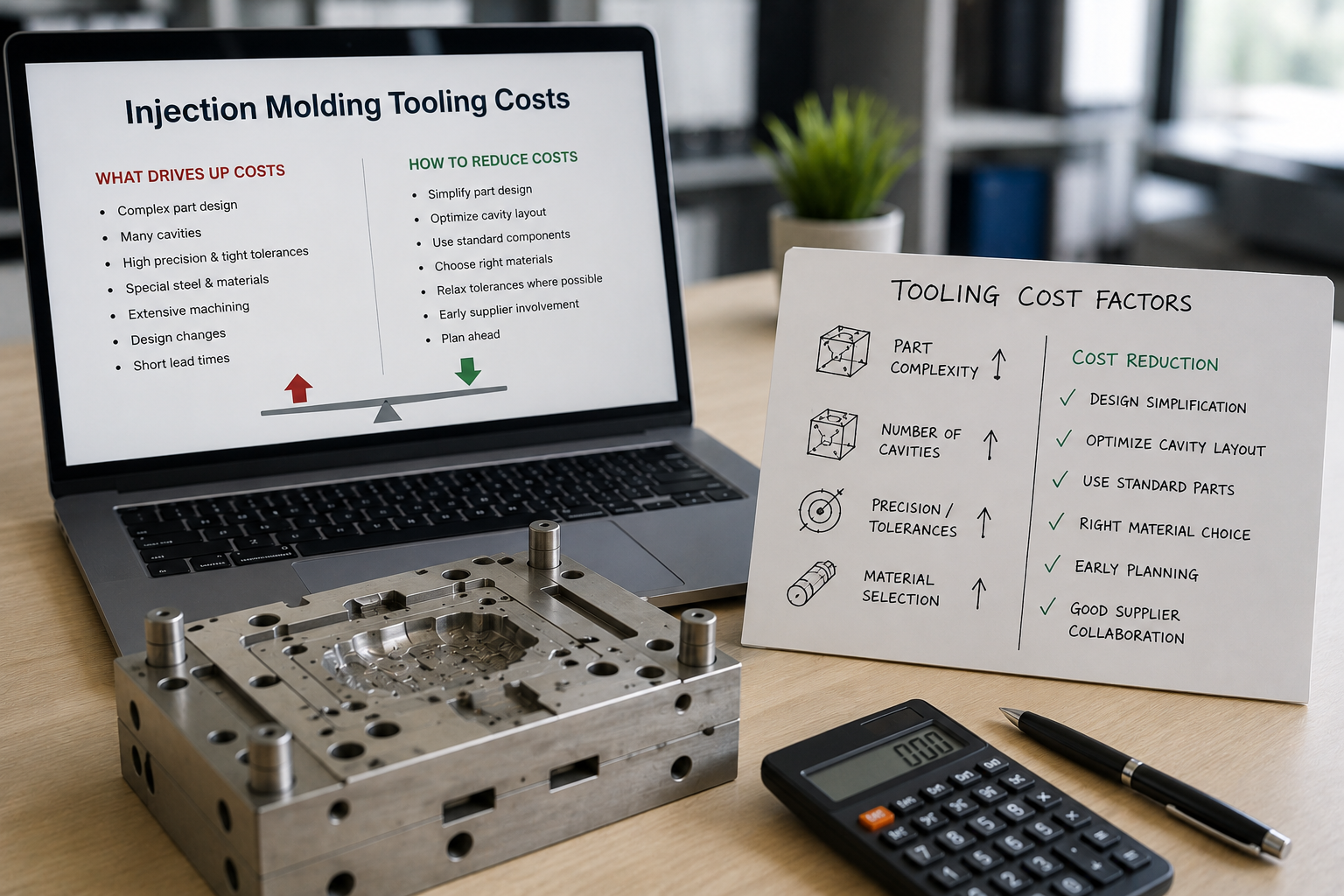
Nineteen variables account for most of the difference between two quotations. Reading a quote against them turns a mysterious number into an explainable one.
Part size. Larger parts need more steel, bigger mold bases, larger machines, and longer cooling. Cost scales with the volume of steel to be machined and hardened.
Product complexity. Intricate geometry — deep ribs, thin walls, fine features — demands more precision machining and EDM. Complexity is the clearest single indicator of where a quote will land.
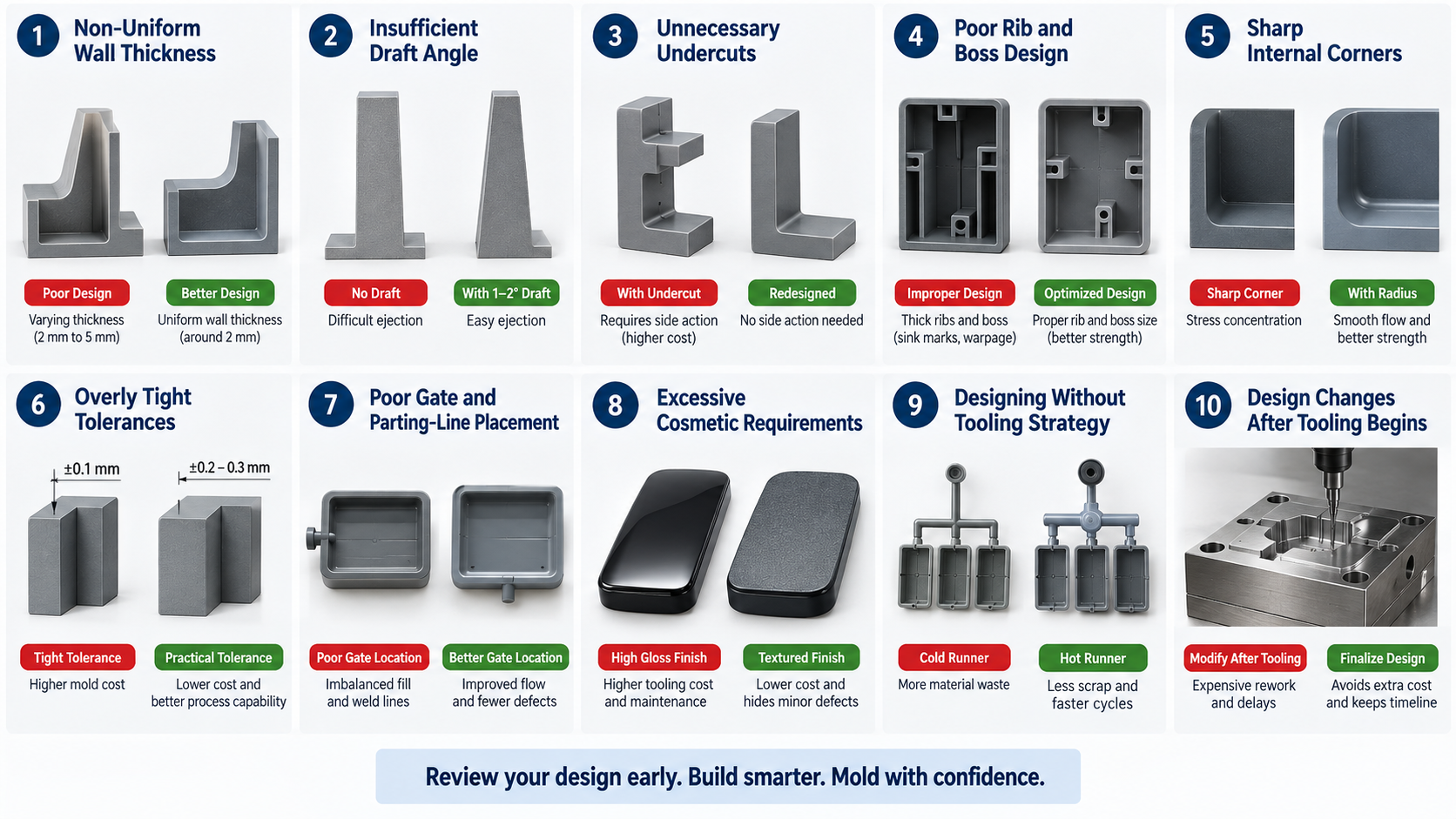
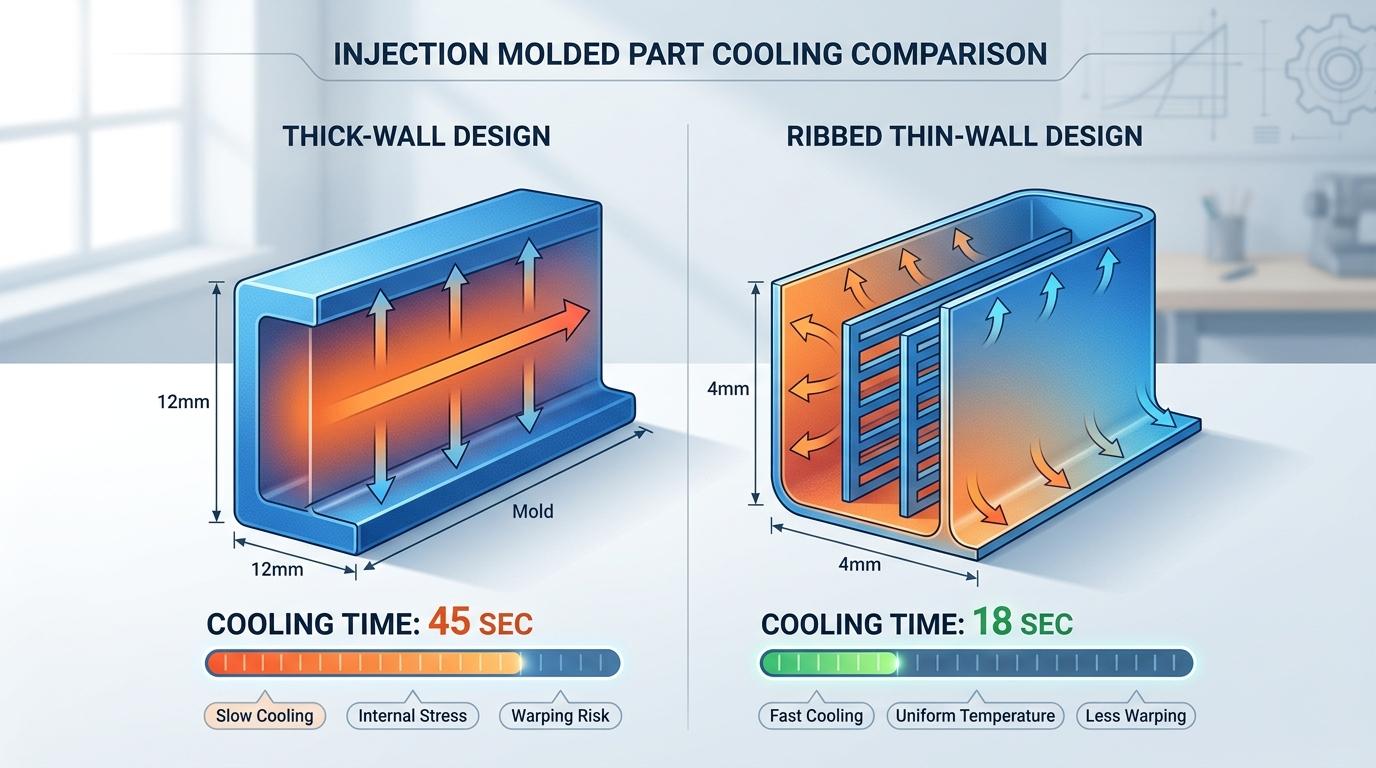
Wall thickness. Non-uniform walls cause sink and warpage and force compensating tool features; very thin walls (below ~0.5 mm) require high-speed machines and precise tooling. Uniform, sensible wall thickness lowers cost.
Material selection. Abrasive, glass-filled, or flame-retardant resins wear tools faster and require harder steel. The resin also drives gate design, cooling, and shrinkage compensation.
Mold steel grade. Pre-hardened steels (e.g. P20) are economical and faster to machine, suiting lower to medium volumes. Hardened steels (e.g. H13) and stainless grades cost more but resist wear and corrosion — essential for high volumes and abrasive resins.
Number of cavities. The biggest lever on both tooling cost and per-part cost. More cavities cost more upfront but slash cost per part at volume.
Surface finish. The part finish mirrors the tool finish. A standard machined finish is cheap; a fine polish or A-class cosmetic finish adds skilled hours and often a better steel.
Texturing. Applied textures (e.g. to a VDI 3400 or Mold-Tech reference) add a finishing operation to the tool. Cite the standard and grade where known.
Tolerance requirements. Tight tolerances (±0.02 mm vs ±0.1 mm) demand precision machining, better steel, and more inspection. Tolerance only what is functionally critical.
Cooling design. Well-engineered cooling — including conformal channels where warranted — costs more to build but shortens every cycle, compounding savings across the run.
Hot runner vs cold runner. A hot runner costs significantly more upfront but eliminates runner scrap and shortens cycles; at high volume it repays itself many times over. A cold runner is more economical for short runs.
Side actions. Slides that retract to release external undercuts add machining, moving parts, and maintenance.
Lifters. Angled mechanisms that clear internal undercuts during ejection — each adds cost and ongoing maintenance.
Unscrewing mechanisms. Required to release threaded parts; these are among the more complex and costly mold mechanisms.
Automation. Features for robotic part removal, in-mold labelling, or automated insert loading add build cost but lower labour cost and raise consistency at volume.
Mold life expectancy. Designed in through steel, hardness, and cooling, and measured in shots. A tool for 1 lakh shots is cheaper than one for 10 lakh or 1 crore shots. Match life to volume.
Engineering design time. Complex tools require more design, DFM, and mold-flow hours before machining begins — real cost, and real risk reduction.
Mold testing. Trials (T0, T1, T2) consume machine time and material to validate the tool before production.
Trial runs and sampling. Producing and inspecting first-article parts, iterating until dimensions and cosmetics are approved, is a genuine line item in the total cost.
Hidden Costs Buyers Often Overlook
The quoted mold price is rarely the total cost of ownership. Experienced buyers budget for these; first-time buyers get caught out by them.
- Mold maintenance. Ejector pins, springs, seals, and hot-runner tips wear and need periodic service over the tool's life.
- Design changes and engineering modifications. Changes after steel is cut are far more expensive than fixes on the drawing — reworking hardened steel can cost many times a paper-stage fix.
- Sampling and validation. Multiple sample rounds, dimensional (CMM) reports, and part approval take time and material.
- Shipping and logistics. For international buyers, freighting the tool or the parts, plus in-transit protection, adds real cost.
- Packaging. Export packing (anti-static, moisture barrier, cartons, pallets) is easy to omit from a budget.
- Spare components. Holding critical spares avoids downtime but is an upfront cost.
- Mold storage. Tools between production campaigns need proper storage and periodic preservation.
- Repair costs. Accidental damage or wear-related repair over a long programme.
- Duties and taxes. Import duties vary by destination and can materially change landed cost.
A quotation that looks cheap often becomes expensive once these surface. A slightly higher quote from a partner who includes DFM, mold flow, trials, and inspection frequently proves cheaper — and far less risky — in total.
Country Comparison: India vs China, USA, Germany, Vietnam
International buyers rarely evaluate India in isolation. The table below compares the major sourcing regions on the factors that matter for a tooling decision. Figures are indicative 2026 market observations for an equivalent commercial-grade mold; your project will vary.
| Factor | India | China | USA | Germany | Vietnam |
|---|---|---|---|---|---|
| Relative tool cost | Low–moderate | Lowest–low | Highest | Very high | Low |
| Example Class-A mold | ~$12k–22k | ~$8k–15k | ~$25k–60k+ | ~$30k–70k+ | ~$8k–16k |
| Lead time | Moderate (~7–12 wks) | Fast (~6–10 wks) | Moderate–fast | Longer | Moderate |
| Engineering support | Strong, growing | Strong, mature | Very strong | Very strong | Developing |
| Quality | High, improving | High, variable by vendor | Very high | Very high (precision) | Improving |
| Communication | English-fluent, strong | Variable, time-zone gap | Native | Strong | Developing |
| After-sales support | Good | Good | Very good | Very good | Developing |
| IP protection | Strong | Variable | Very strong | Very strong | Developing |
| Total cost of ownership | Very competitive | Competitive | High | High | Competitive |
How to read this. China remains the global cost-and-speed benchmark with the deepest ecosystem, and it is often ahead on complex cosmetic tooling. But the gap to India has narrowed, and India brings real advantages that matter to Western and Middle Eastern buyers: English-fluent communication, strong IP protection, and — for US-bound goods in particular — a materially more favourable tariff position, which can swing total landed cost decisively in India's favour. Germany and other European sources lead on precision but sit 30–60% above China on price. Vietnam is an emerging low-cost option with a less mature tooling ecosystem than China or India.
The practical takeaway for a sourcing team: compare landed, lifetime cost, not factory-gate tool price. Normalise every quote for Incoterms, freight, duties, lead time, communication, and after-sales support before you decide. On that basis, India is one of the most competitive tooling sources in the world for the majority of commercial programmes.
How Buyers Can Reduce Tooling Costs
Real savings come from engineering decisions, not from cutting corners on the tool.
- Invest in a DFM review before cutting steel. The single highest-return decision in the project — a fix on the drawing costs a fraction of a fix in hardened steel.
- Choose material by requirement, not habit. Over-specifying to a premium engineering grade raises tooling and part cost together.
- Use standard components. Standard mold bases, ejector pins, and hot-runner components are cheaper and faster than bespoke ones.
- Optimise the design. Remove unnecessary undercuts (eliminating a slide or lifter), add draft, and equalise wall thickness.
- Apply appropriate tolerances. Tight only on functional dimensions; general tolerances elsewhere.
- Consolidate parts. Combining two components into one well-designed part can remove a whole tool and an assembly step.
- Plan for the long term. Share your real lifetime volume so the tool is right-sized once — avoiding an expensive re-tool later. Ordering parts alongside the tool can also reduce logistics and unit cost.
Applied together, these routinely cut tooling cost by a meaningful margin while improving part quality.
Common Mistakes Buyers Make
- Choosing the lowest quote without checking scope. Steel grade, cavities, and inspection differ between quotes; the cheapest is often the least complete.
- Ignoring lifetime volume when scoping tooling. Under-specifying cavities and mold life to save upfront leads to a higher part cost and early re-tooling.
- Committing to production tooling before freezing the design. Every change after steel is cut is expensive.
- Over-tolerancing and over-finishing. Applying tight tolerances and mirror finishes everywhere inflates cost with no benefit.
- Overlooking total cost of ownership. Freight, duties, maintenance, and reliability belong in the comparison.
- Comparing quotes on different assumptions. The classic apples-to-oranges error — normalise scope and Incoterms first.
- Skipping DFM. The most expensive mistake of all, because it hides problems until they are costly to fix.
Injection Mold Cost vs Long-Term ROI
The cheapest tool is frequently the most expensive choice over a product's life. Consider the amortisation logic: a ₹5 lakh tool (≈ $6,000) spread across 500,000 parts adds just ₹1 per part; the same tool over 5,000 parts adds ₹100. Volume, not the sticker price, decides the real cost.
A higher-cost tool is the better investment when:
- Volumes are high — multi-cavity, hot-runner, hardened-steel tooling collapses the per-part cost.
- The part is dimensionally critical — precision tooling that holds tolerance for the full life prevents rejects and line stoppages downstream.
- The resin is abrasive or corrosive — premium steel avoids premature wear and mid-programme re-tooling.
- The finish is customer-facing — a tool built to hold an A-class finish protects your brand on every part.
- Uptime matters — better cooling and ejection run faster and more reliably.
A "cheap" mold with long cycle times and constant fixes is, over a multi-year programme, almost always the costliest option. The right question remains total cost per part across the life of the tool — and on that measure, engineering quality usually pays for itself.
Real Manufacturing Example
Illustrative example; figures are indicative.
The situation. An international consumer-appliance OEM needed a housing at roughly 2 million parts per year, with a visible A-class surface and several assembly-critical dimensions. Their initial enquiry, based on a single-cavity cold-runner concept, looked inexpensive on paper — around ₹4 lakh.
The engineering review. A DFM review flagged three issues: non-uniform wall sections that would cause sink on the cosmetic face, two undercuts each needing a slide, and a globally tight tolerance that only two dimensions actually required. Mold-flow analysis showed a weld-line risk near a visible edge.
The revised approach. Wall sections were equalised and one undercut was designed out, removing a slide. Tolerances were relaxed on non-critical dimensions. The tool was re-scoped as a 4-cavity hardened-steel mold with a hot runner and an optimised cooling circuit — around ₹16 lakh.
The outcome. The revised tool cost roughly four times the naive concept upfront, but the four cavities and hot runner cut the per-part cost sharply, the cooling design shortened the cycle by around 20%, and the cosmetic defects were eliminated before steel was cut. Across the annual volume, the higher-cost tool delivered a materially lower total cost per part — and a part that met the brand's surface standard on every shot. The apparent saving of the cheaper concept would have been erased within the first production quarter by scrap and slower cycles.
The lesson. The lowest quotation and the lowest cost are rarely the same thing. Engineering the tool around volume, criticality, and finish — before cutting steel — is where the real money is made or lost.
Why International Buyers Choose Indian Mold Manufacturers
India has become a preferred tooling source for OEMs across North America, Europe, the Middle East, and Asia-Pacific, and the reasons are practical, not promotional:
- Skilled workforce. A deep pool of experienced tool designers, machinists, and mold engineers.
- Competitive pricing. Tooling typically 40–60% below Europe and the USA for equivalent quality, and increasingly competitive with China on total landed cost.
- Export experience. Established exporters who understand Incoterms, documentation, packaging, and the expectations of overseas buyers.
- Engineering capability. DFM, mold-flow analysis, and precision machining on modern CAD/CAM platforms.
- Global quality standards. ISO-certified quality systems, CMM inspection, and process-capability data suited to regulated and export markets.
- Faster, clearer communication. English fluency removes the friction that slows cross-border tooling projects.
- Strong IP protection and a willingness to work under NDA.
- Long-term partnerships. A partner mindset — supporting programmes from prototype through mass production and scaling with demand.
For buyers weighing sourcing options, India offers a rare combination: strong engineering, competitive economics, and low-friction communication — provided you choose a partner with genuine in-house capability and documented quality systems.
Frequently Asked Questions
Indicatively, from around ₹80,000 for a simple prototype tool to ₹40 lakh or more for a large, high-precision, multi-cavity or hot-runner mold. Most commercial production tooling sits in the ₹4–15 lakh range. The exact figure depends on part size, complexity, material, tolerances, cavities, and finish, and can only be confirmed from a reviewed drawing.
Because price is driven by specification, not part size. Different steel grades, cavity counts, runner types, tolerances, and inspection scopes can change the number several-fold. Always compare what is included, not just the headline total.
For early volumes, a single-cavity aluminium or soft-steel (bridge) tool is the most economical, at a higher per-part price. It lets you validate the design before committing to a production tool.
Typically 40–60% lower for equivalent quality, driven by competitive labour and overhead. When tariffs and freight are included, the total-cost advantage for US-bound goods can be larger still.
Yes, from a capable partner. Look for ISO 9001:2015 certification, in-house machining, DFM and mold-flow capability, and CMM inspection with documentation. These distinguish an export-grade toolmaker from a low-cost job shop.
Tooling lead times commonly run from several weeks to a few months depending on complexity. Compressing the schedule usually carries a premium for additional shifts and expedited components.
A hot runner costs significantly more upfront but eliminates runner scrap and shortens cycle time, paying back at high volume. A cold runner is cheaper to build and better suited to lower volumes.
For a customer-funded OEM tool, you should normally expect to own it, with your designs protected under an NDA. Confirm ownership, storage, maintenance, and confidentiality in writing before committing.
Invest in a DFM review before cutting steel, right-size steel and mold life to your real volume, use standard components, tolerance only critical dimensions, and design out unnecessary undercuts.
More cavities raise the tooling cost but lower the cost per part at volume, because each cycle produces more parts. The right count is a function of your annual volume.
A 3D CAD model (STEP preferred), a 2D drawing with critical dimensions and tolerances, the material grade or application, your annual volume, and any finish, colour, and packaging requirements.
Frequently, yes. At high volume, or for critical or cosmetic parts, a higher-cost tool with more cavities, better cooling, and harder steel delivers a lower total cost per part and fewer rejects across the life of the programme.
Why Choose FD Group
FD Group brings precision mold manufacturing and injection molding together under one group, giving international buyers a single, accountable partner from tool design to production parts. Tooling is engineered at FIFO Industries, the group's mold manufacturing plant, while FIFO Polymers handles high-precision injection molding — so your programme moves from steel to shipped parts without outsourcing delays.
What that means for your project:
- Engineering expertise and tool-design support. A dedicated design team on licensed NX and VISI CAD/CAM, with mold-flow analysis to validate designs before steel is cut.
- DFM assistance at the quotation stage. We review your drawing for manufacturability and flag cost and quality issues while they are still cheap to fix.
- Precision manufacturing in-house. VMC, EDM, CNC wire cutting, and grinding under one roof — quality and schedule under our direct control.
- Quality assurance. ISO 9001:2015 certified systems, CMM dimensional inspection, process-capability (Cpk) tracking, and material traceability from raw material to finished part.
- Transparent pricing. Clear, itemised quotations scoped to your volume and quality targets — not a black-box number.
- Prototype to mass production. Support across the full journey, with capacity to scale from 10,000 to 10 million units.
- Export support and reliable delivery. Clear engineering communication, competitive economics, confidentiality under NDA, and dependable on-time delivery for overseas programmes.
- A long-term partnership mindset. A decade of experience and 1,200+ delivered projects across India and international markets, spanning automotive, consumer goods, healthcare, and defence.
Send us your part and you will get back a transparent, engineering-backed quotation — scoped around your total cost per part, not the cheapest number on the page.
Conclusion
The honest answer to "how much does an injection mold cost in India?" is a range — and now you know exactly what decides where your tool lands within it. Part size, complexity, steel grade, cavities, cooling, runner type, tolerances, finish, and mold life together determine whether a tool costs ₹80,000 or ₹40 lakh. The quoted price is only part of the story; DFM, trials, inspection, freight, duties, and maintenance make up the true cost of ownership.
For international buyers, India offers a compelling combination of competitive tooling economics, strong engineering, English-fluent communication, and — increasingly — a favourable total-cost position against every major sourcing region. The buyers who win are the ones who scope tooling around lifetime cost per part, validate the design before cutting steel, and choose a partner with genuine capability rather than the lowest quote.
Do that, and the mold becomes exactly what it should be: an investment that pays back on every part you produce, for years.
Request a Quote
Ready to price your project? Share your part drawing with FD Group's tooling engineers for a DFM review and a transparent, itemised quotation scoped to your volume and quality targets — from prototypes and bridge tooling to full-scale export production.
Get in Touch with Our Engineering Team
Request a Quote, Discuss Your Project, Talk to Our Tooling Engineers, or Start Your OEM Manufacturing Project at www.fdgroup.co.in.
Request a Quote / DFM ReviewPeople Also Ask (target questions)
- How much does it cost to make a plastic injection mold?
- Why are injection molds so expensive?
- Is injection molding cheaper in India or China?
- How long do injection molds last?
- What is the minimum order for injection molding?
- How do I get an injection molding quote?
Related Blog Suggestions
- What Drives Up Injection Molding Tooling Costs — and How to Reduce Them
- MOQ in Injection Molding: What Buyers Need to Know
- How to Get an Accurate Injection Molding Quote
- Hot Runner vs Cold Runner Molds: A Cost and Performance Guide
- Bridge Tooling vs Production Tooling: Which Is Right for Your Launch?
- Mold Steel Guide: P20, H13, and When Each Makes Sense
Internal Link Suggestions
- What Drives Up Injection Molding Tooling Costs →
/blog/injection-molding-tooling-cost-drivers-how-to-reduce - MOQ in Injection Molding →
/blog/moq-in-injection-molding-buyers-guide - How to Get an Accurate Injection Molding Quote →
/blog/how-to-get-accurate-injection-molding-quote - FIFO Industries — Precision Mold Manufacturing →
/mold-manufacturing - FIFO Polymers — Injection Molding Services →
/injection-molding - Request a Quote →
/contact